Integrating Faith and Learning: The Strategic Value of the Christian Alphabet F is for Fish Page
In the evolving landscape of educational resources, there is a distinct shift toward materials that do more than just convey information; they aim to shape values and worldviews. For parents, Sunday school educators, and faith-based entrepreneurs, the Christian Alphabet F is for Fish Page represents more than a simple coloring sheet. It is a strategic tool designed to bridge the gap between early literacy development and foundational theological concepts. As the market for digital educational assets grows, creators are finding that products which seamlessly blend curriculum with character building are seeing increased demand and engagement.
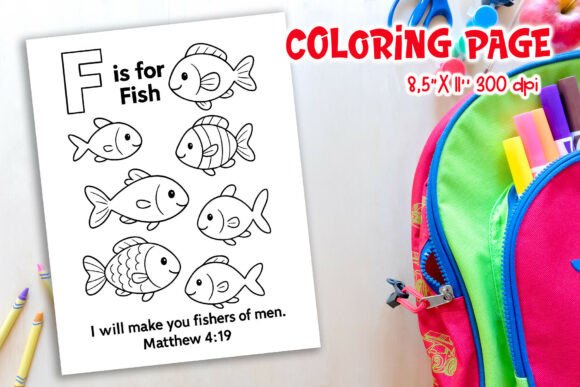
This specific resource, centered on the letter "F," leverages the powerful imagery found in Matthew 4:19: "I will make you fishers of men." By anchoring an alphabet lesson in Scripture, the design transforms a routine learning activity into a meaningful spiritual exercise. For professionals in the education sector and content creators alike, understanding the mechanics and market appeal of such resources provides insight into the broader trends shaping faith-based consumer behavior.
The Convergence of Literacy and Spiritual Formation
The traditional approach to teaching the alphabet often relies on secular associations—A is for Apple, B is for Ball. While effective for phonetic recognition, these methods lack the contextual depth required for families and institutions seeking to integrate their faith into daily routines. The Christian Alphabet F is for Fish Page addresses this gap by offering a dual-purpose educational model. It serves as a vehicle for cognitive development while simultaneously planting seeds of biblical truth.
For homeschooling families and Sunday school directors, the workflow has changed. There is no longer a desire to compartmentalize "school time" from "faith time." Instead, the expectation is for a holistic integration where every subject reinforces the family's or community's core beliefs. This product fits perfectly into that workflow. When a child colors the fish and discusses the concept of being a "fisher of men," they are not just practicing fine motor skills; they are engaging in a narrative that connects them to the Great Commission. This alignment meets the changing preferences of modern consumers who value efficiency and depth in their educational materials.
Why the "Fishers of Men" Narrative Resonates
The choice of Matthew 4:19 for the letter "F" is not arbitrary; it is a deliberate pedagogical decision. The verse introduces one of the most enduring metaphors in Christian theology. For young learners, the image of a fish is tangible and recognizable, making it an ideal anchor for abstract concepts like evangelism and discipleship. By visualizing the fish, children can begin to grasp the idea of gathering people for God's kingdom in a way that is age-appropriate and memorable.
From a creative standpoint, this approach demonstrates how semantic relevance enhances retention. When a learner associates a letter with a story they understand and value, the memory trace is stronger. This is why the Christian Alphabet F is for Fish Page is gaining traction among educators who are looking for high-impact, low-preparation tools. It removes the burden on the teacher to create custom materials, providing a ready-made solution that is both visually appealing and theologically sound.
Market Trends and the Rise of Digital Educational Assets
The demand for downloadable educational resources has surged, driven by the need for flexibility and cost-effectiveness. In the current economic climate, parents and small ministry leaders are looking for solutions that offer immediate utility without the delay of shipping physical goods. The Christian Alphabet F is for Fish Page, delivered as a high-quality JPEG file (8.5 x 11 inches, 300 DPI), caters directly to this trend. It allows users to print the material instantly, customize it if necessary, and reuse it across multiple sessions or classrooms.
This shift reflects a broader industry movement toward digital-first content creation. Entrepreneurs and freelancers in the education niche are recognizing that high-resolution, printable assets are a scalable business model. Unlike physical inventory, digital files have zero marginal cost of reproduction, allowing creators to focus on quality and design rather than logistics. For the consumer, this means access to professional-grade materials at a fraction of the cost of traditional textbooks or workbooks.
Furthermore, the rise of remote learning and hybrid schooling models has accelerated the adoption of these digital tools. Whether used in a home setting or a church basement, the ability to download a resource and immediately put it to use is a significant advantage. The Christian Alphabet F is for Fish Page exemplifies this utility, serving as a versatile component in a larger ecosystem of faith-based learning activities.
Design Standards and Professional Expectations
As the market becomes more saturated, the bar for quality continues to rise. Consumers are no longer satisfied with pixelated images or poorly formatted documents. The specification of 300 DPI for this coloring page is a critical detail that speaks to professional standards. High resolution ensures that when printed, the lines are crisp, the details are clear, and the final product looks polished. This attention to detail builds trust between the creator and the user.
For marketers and brand builders, maintaining high production values is essential for reputation management. A blurry or low-quality image can undermine the perceived value of the entire product line. By delivering a file that meets professional printing standards, creators signal reliability and competence. This is particularly important in the faith-based sector, where trust and integrity are paramount. Parents and educators want to know that the materials they are using are crafted with care and respect for their mission.
Practical Applications in Diverse Settings
The versatility of the Christian Alphabet F is for Fish Page extends across various environments, making it a valuable asset for different types of users. In a Sunday school setting, it can serve as the centerpiece for a lesson on the calling of the disciples. Teachers can use the coloring activity as a quiet time exercise while discussing the sermon, allowing children to internalize the message through art.
For homeschooling families, the page integrates seamlessly into language arts curricula. It can be part of a morning basket activity, a handwriting practice session, or a discussion starter about the Bible stories. The ability to combine alphabet learning with Scripture study streamlines the educational process, saving time and reducing the need for multiple resources.
- Bible Study for Kids: Use the page to illustrate the concept of discipleship, encouraging children to draw themselves as "fishers of men."
- Faith-Based Activities: Incorporate the coloring page into craft projects, such as creating paper fish mobiles or bulletin board displays.
- Alphabet Learning: Reinforce letter recognition by having children trace the letter "F" before coloring the fish illustration.
These practical examples highlight how a single resource can adapt to various needs and workflows. The key is its flexibility. Whether used for individual study or group instruction, the Christian Alphabet F is for Fish Page provides a consistent, high-quality experience that supports the educational and spiritual goals of the user.
Future Directions in Faith-Based Education
Looking ahead, the intersection of technology, education, and faith will continue to evolve. We can expect to see more sophisticated digital tools that build upon the foundation laid by resources like this coloring page. Interactive versions, augmented reality experiences, and gamified learning modules may emerge, but the core principle remains the same: the need for content that is both engaging and meaningful.
Creators and entrepreneurs should anticipate a growing demand for personalized, context-rich educational materials. As families become more intentional about their values, they will seek out resources that reflect those priorities. The success of the Christian Alphabet F is for Fish Page suggests that there is a robust market for products that honor tradition while embracing modern delivery methods.
Moreover, the emphasis on high-quality design and professional presentation will only increase. As digital literacy improves among consumers, so too will their expectations for the visual and functional aspects of educational content. Creators who prioritize these elements will be well-positioned to lead in this competitive space.
Conclusion
The Christian Alphabet F is for Fish Page is a testament to the power of thoughtful design in education. By combining the fundamental task of learning the alphabet with the profound message of Matthew 4:19, it offers a unique value proposition that resonates with today's faith-driven consumers. For professionals, creators, and enthusiasts in the field, it serves as a model of how to create resources that are not only useful but also transformative.
As we navigate the changing landscape of education and faith formation, tools like this remind us that the simplest ideas, when executed with intention and quality, can have the greatest impact. Whether used in a classroom, a home, or a church, the Christian Alphabet F is for Fish Page stands as a beacon of hope and learning, inviting children to discover the joy of knowing God through the lens of His Word.
Thank you for visiting my shop and exploring the possibilities of faith-based education. May your journey in creating and utilizing these resources be filled with inspiration and purpose.