Mastering Letter Formation: The Strategic Value of Arrows Lined Letter Tracing in Modern Education
In the rapidly evolving landscape of early childhood education and special needs support, the tools educators use to build foundational skills are undergoing a significant transformation. While digital tablets and interactive whiteboards have become ubiquitous, there is a resurgent appreciation for tactile, analog learning methods that prioritize fine motor development and cognitive sequencing. At the forefront of this movement is Arrows Lined Letter Tracing, a specialized approach that combines visual cues with structural guidance to teach correct letter formation. For teachers, curriculum designers, and educational entrepreneurs, understanding the mechanics and market potential of these resources is essential for creating high-impact learning materials.
The Mechanics of Visual Guidance in Handwriting Instruction
Traditional handwriting instruction often relies on rote memorization or simple imitation, which can be inefficient for young learners struggling with spatial awareness or motor planning. Arrows Lined Letter Tracing addresses these challenges by integrating directional indicators directly into the typography itself. This method transforms a static letter into a dynamic roadmap, guiding the student's hand through the precise stroke order required to form each character correctly.
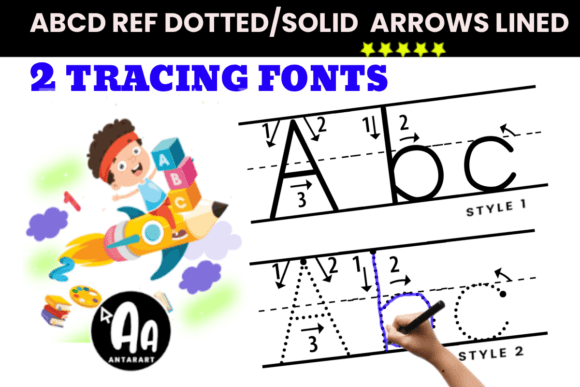
The core innovation lies in the combination of three distinct elements: the lined background for vertical alignment, the dotted font style for tracing practice, and the embedded arrows indicating direction. When a teacher utilizes a Letter Tracing Font set designed with these features, they are not merely providing a worksheet; they are delivering a scaffolded learning experience. The arrows serve as an externalized thought process, showing the child exactly where to start, how to move, and when to stop. This reduces cognitive load, allowing students to focus on the physical act of writing rather than guessing the sequence of movements.
Bridging the Gap Between Theory and Practice
For professionals in the education sector, the shift toward arrow-guided fonts represents a move away from abstract instruction toward concrete application. In the context of ABC Dotted Arrows Lined activities, the font acts as a bridge between the theoretical concept of a letter and the physical execution of writing it. This is particularly critical for preschool and kindergarten students who are just beginning to develop the fine motor skills necessary for holding a pencil and controlling pressure.
Furthermore, this approach aligns with contemporary pedagogical theories that emphasize multisensory learning. By engaging visual processing (seeing the arrows), kinesthetic memory (feeling the movement), and proprioception (understanding body position), these tracing activities create robust neural pathways. As a result, students are more likely to retain the correct formation of letters, leading to improved legibility and writing speed in later grades.
Market Trends and the Demand for Specialized Educational Tools
The demand for high-quality handwriting resources is not merely a niche interest; it reflects broader trends in the education market. As schools and homeschooling families increasingly recognize the correlation between handwriting proficiency and literacy outcomes, there is a growing appetite for tools that make teaching easier and more effective. Arrows Lined Letter Tracing has emerged as a key solution in this space, catering to a diverse audience including ESL learners, children with dysgraphia, and neurodivergent students who benefit from explicit visual instructions.
From a business perspective, the creation of digital assets using these fonts presents a lucrative opportunity for creators and freelancers. The ability to generate hundreds of unique worksheets from a single Letter Formation font bundle allows for scalable content production. Educators and entrepreneurs alike are recognizing that a well-designed font set is not just a graphic element but a functional tool that solves a specific problem. This utility drives value, making these resources highly desirable in online marketplaces dedicated to teaching materials.
Adapting to Changing Workflows and Expectations
The modern educator faces increasing pressure to differentiate instruction and accommodate diverse learning styles within a single classroom. Time constraints often make it difficult to create custom materials from scratch. Here, the versatility of Arrows Lined Letter Tracing fonts becomes a strategic asset. Teachers can quickly customize text, insert names, or create targeted practice sheets for specific letters without needing advanced design skills.
This efficiency supports a workflow where preparation time is minimized, and instructional time is maximized. Whether designing fine motor centers for a kindergarten classroom or creating digital activities for remote learning, the flexibility of these fonts allows professionals to adapt to changing needs instantly. The trend is moving towards "ready-to-use" yet "highly customizable" resources, and these tracing fonts sit perfectly at that intersection.
Practical Applications Across Diverse Learning Environments
The utility of Arrows Lined Letter Tracing extends far beyond the traditional elementary classroom. Its applications are vast, serving various sectors of the educational ecosystem:
- Preschool and Kindergarten: These environments rely heavily on play-based learning and skill-building activities. Using a Letter Tracing Font set with solid and dotted styles allows teachers to introduce the alphabet in a structured yet engaging way. The arrows provide the necessary scaffolding for children who are just beginning to understand the concept of left-to-right progression.
- Homeschooling Families: Parents acting as primary educators often seek comprehensive curricula that cover all bases. A font bundle based on traditional school handwriting styles offers a standardized approach that ensures their children are meeting developmental milestones. The ability to print endless variations of ABC Dotted Arrows Lined pages makes it easy to maintain consistency in daily practice.
- ESL and Language Acquisition: For students learning English as a second language, the visual clarity of arrow-guided letters is invaluable. It removes the ambiguity of how letters are formed, allowing students to focus on pronunciation and vocabulary while simultaneously mastering the written script.
- Special Education: Students with motor planning difficulties or dyslexia often struggle with letter reversal and inconsistent sizing. The directional arrows in these fonts act as a constant visual reminder, helping to internalize the correct stroke order and reduce errors over time.
Building Confidence Through Mastery
One of the most profound impacts of using Arrows Lined Letter Tracing is the psychological boost it provides to young learners. Handwriting can be a source of frustration for many children, leading to anxiety and avoidance behaviors. By breaking down the complex task of writing into manageable, guided steps, these tools foster a sense of achievement. Every completed line reinforces the student's belief in their ability to write, building the confidence necessary to tackle more complex writing tasks.
For teachers, witnessing this progress is a powerful motivator. It validates the choice of materials and demonstrates the effectiveness of evidence-based practices. The transition from hesitant scribbling to confident, legible writing is a milestone that defines early academic success, and the right tools are instrumental in achieving it.
Future Outlook: Integrating Tradition with Innovation
As we look toward the future of education, the integration of technology and traditional methods will continue to define the industry. While digital devices offer interactive experiences, the fundamental need for pen-and-paper practice remains undeniable. Arrows Lined Letter Tracing represents a harmonious blend of old and new, utilizing modern typographic design to enhance a timeless skill.
The evolution of these fonts suggests a future where customization is even more granular. We may see adaptive fonts that change arrow density based on student performance or digital versions that track stroke pressure and speed. However, the core principle remains unchanged: clear, visual guidance leads to better learning outcomes. For creators and marketers in the education space, investing in high-quality, arrow-integrated font sets is a forward-looking strategy that aligns with the enduring needs of students and educators.
Ultimately, the value of Letter Formation tools like these lies in their ability to empower both the teacher and the learner. They transform a potentially tedious task into an engaging, structured activity that builds lifelong skills. By embracing these resources, the education community can ensure that every child has the opportunity to develop strong handwriting foundations, setting them up for success in all areas of literacy and communication.