Student Wearing Vr Headset in Classroom: The Shift Toward Immersive Learning
The image of a Student Wearing Vr Headset in Classroom has transitioned from a futuristic concept found in science fiction to a tangible reality reshaping modern education. This visual is no longer just about the hardware; it represents a fundamental shift in how knowledge is transmitted, absorbed, and experienced. As educational institutions worldwide grapple with the need to engage a digital-native generation, the integration of virtual reality (VR) offers a solution that goes beyond the traditional lecture hall. It transforms passive listening into active participation, turning abstract concepts into immersive experiences.
For educators, administrators, and technology professionals, understanding this shift is crucial. It is not merely a trend but a response to evolving user expectations and the limitations of conventional teaching methods. When a student dons a headset, they are transported from a static desk to a dynamic environment where history comes alive, molecules can be manipulated by hand, or complex engineering systems can be explored without physical risk. This evolution marks a pivotal moment in the intersection of technology and pedagogy.
Redefining the Educational Landscape Through Immersion
The relevance of a Student Wearing Vr Headset in Classroom lies in its ability to solve long-standing challenges in education: engagement, retention, and accessibility. Traditional learning often relies on two-dimensional representations—textbooks, whiteboards, and slides—which require students to visualize complex ideas mentally. VR removes this barrier by providing a direct sensory experience. Instead of reading about the human circulatory system, a student can shrink down and travel through the veins, observing blood flow in real-time.
This level of immersion creates a "memory hook" that is difficult to replicate with standard media. The brain processes experiential data differently than auditory or textual data, often leading to deeper cognitive processing and better long-term retention. For universities and colleges, this means that the classroom is no longer confined by four walls. A history lesson can take place in ancient Rome, a biology class can dive into the Great Barrier Reef, and an art class can step inside a Van Gogh painting. The potential for interactive learning is limitless, offering a new dimension to the pursuit of knowledge.
Furthermore, this technology addresses the diverse learning styles present in any group of classmates. While some students thrive on verbal instruction, others learn best through kinesthetic or visual means. VR provides a versatile platform that caters to these different needs simultaneously, ensuring that the lesson is accessible to a broader range of learners. It democratizes access to experiences that might otherwise be impossible due to cost, geography, or safety concerns.
From Concept to Reality: The Evolution of Visual Assets
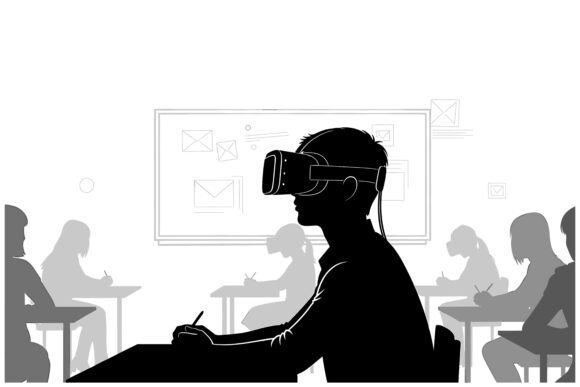
The journey of VR in education is mirrored in the visual language used to represent it. Consider the iconography of a Student wearing vr headset in classroom silhouette. This specific visual motif—a black and white outline of a learner engaged with technology—has become a powerful symbol of the future of education. In the realm of graphic design and marketing, such silhouettes serve as more than just illustrations; they encapsulate the essence of innovation and the modern student experience.
Designers and content creators often utilize high-quality files, such as an EPS file or a JPG file, to communicate these concepts effectively. The versatility of a silhouette allows it to be adapted across various mediums, from university brochures to tech conference presentations. The stark contrast of black and white emphasizes the form and action over color, focusing the viewer's attention on the interaction between the human and the machine. This minimalist approach reflects the clarity of purpose behind integrating VR: to focus on the learning outcome rather than the distraction of the tool itself.
As the technology matures, the imagery surrounding it has evolved from flashy, colorful renderings to more grounded, realistic depictions. We see fewer sci-fi tropes and more practical scenes of students sitting at desks, taking notes, or collaborating with teachers while wearing headsets. This shift in visual representation signals a move toward normalization. VR is no longer seen as a novelty or a gaming accessory but as a legitimate educational tool, much like the computer or the tablet before it.
The Role of Digital Assets in Communicating Innovation
For businesses and educational marketers, having the right visual assets is critical. A well-crafted illustration of a student wearing a VR headset can instantly convey the message of modernization and forward-thinking. Whether used in a presentation to school boards, a website for a new learning management system, or a promotional campaign for ed-tech startups, these graphics bridge the gap between complex technology and human benefit.
The availability of scalable vector graphics, like EPS files, ensures that these images remain crisp and clear regardless of the display size, from a mobile screen to a large projection board. This technical flexibility supports the professional needs of educators and entrepreneurs who must present their vision clearly and persuasively. The silhouette, in particular, offers a universal appeal, transcending cultural and demographic barriers to represent the global nature of the new generation of learners.
Practical Implications for Educators and Institutions
Integrating VR into the curriculum requires more than just purchasing headsets; it demands a strategic approach to lesson planning and infrastructure. For teachers and professors, the role shifts from being the sole source of information to becoming a facilitator of experiences. They guide students through virtual environments, helping them connect what they see with theoretical frameworks. This change in workflow necessitates professional development and a willingness to adapt to new pedagogical models.
Practical implementation also involves managing logistics. How do schools handle hygiene when multiple students use the same headset? How is software curated to align with state standards? What is the impact on classroom management when students are visually isolated in a virtual world? These are real-world questions that institutions must answer. Successful adoption involves creating protocols that ensure safety, equity, and effectiveness.
Moreover, the economic implications cannot be ignored. While the initial investment in VR hardware and software can be significant, the long-term benefits may outweigh the costs. Virtual field trips eliminate travel expenses, and virtual labs reduce the need for expensive physical equipment and consumables. For business owners in the ed-tech sector, this presents a massive opportunity to develop content that meets these specific needs, moving beyond generic simulations to specialized, curriculum-aligned modules.
Balancing Technology with Traditional Methods
It is important to note that VR is not a replacement for all forms of learning. The most effective classrooms will likely be hybrid environments where digital immersion complements traditional methods like writing, drawing, and face-to-face discussion. A student might spend 20 minutes exploring a virtual historical site and then return to their desk to write an essay or draw a diagram based on their observations. This blend ensures that the technology serves the learning objectives rather than overshadowing them.
The goal is not to create a fully gamified experience but to enhance the depth of understanding. The teacher remains central to the process, interpreting the data and guiding the reflection. The headset is a window, but the educator is the one who helps the student understand what they are seeing. This balanced approach ensures that the focus remains on knowledge acquisition and critical thinking skills.
Future Trends and the New Generation of Learners
As we look toward the future, the prevalence of a Student Wearing Vr Headset in Classroom is expected to grow alongside advancements in hardware and connectivity. Lighter, wireless headsets and higher-resolution displays will make the experience more seamless and comfortable. Additionally, the rise of the metaverse and spatial computing suggests that collaborative virtual spaces will become a staple of higher education, allowing students from different parts of the world to work together on projects in a shared digital environment.
This evolution aligns with the habits of the new generation, who are accustomed to interactive and visual media. For this demographic, learning should be engaging, immediate, and relevant. VR meets these expectations by providing a medium that feels native to their digital lives. However, the challenge remains to ensure that this technology is used ethically and equitably, preventing a divide between those who have access to advanced tools and those who do not.
Ultimately, the story of VR in education is one of empowerment. It gives students the agency to explore, experiment, and discover in ways that were previously impossible. From the simple silhouette of a learner in a classroom to the complex, vibrant worlds they inhabit, the trajectory is clear. The classroom of the future is not just a room with desks and a board; it is a portal to infinite possibilities, driven by innovation and a commitment to the next generation of thinkers and creators.