Online Tutoring Session Focuses on Math: Bridging the Gap Between Digital Tools and Real-World Skills
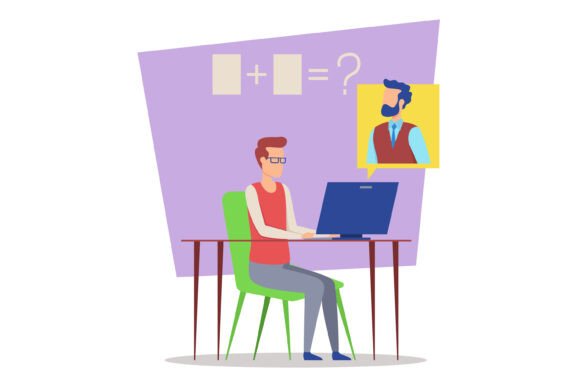
Imagine a scene that has become increasingly familiar in modern households: a student, perhaps an adult returning to education or a professional upskilling for a promotion, sits comfortably at a desk. A laptop screen glows with intricate equations, while a video chat window displays a tutor guiding them through a complex problem with patience and precision. This is not just a static image of remote learning; it is a dynamic illustration of how an Online Tutoring Session Focuses on Math to transform abstract concepts into tangible understanding. The intersection of cutting-edge technology and conventional pedagogical wisdom creates an environment where learning feels less like a chore and more like a collaborative discovery.
At its core, this approach moves beyond simply watching pre-recorded lectures. It is about active engagement. When a session focuses specifically on mathematics, the interaction becomes highly personalized. The tutor can see the student's confusion in real-time, adjusting their explanation from algebraic manipulation to visual geometric representation instantly. This immediacy is what separates effective online tutoring from generic educational videos. It captures the authentic essence of today's e-learning environment, where digital tools serve as the bridge between a learner's current knowledge and their desired mastery.
Navigating Real-World Scenarios Where Math Tutoring Shines
The utility of specialized math tutoring extends far beyond the high school classroom. For adults aged 20 to 50, the need for mathematical proficiency often arises from specific, practical life events rather than academic requirements alone. Consider the professional who finds themselves suddenly needing to analyze data sets for a new role. They might understand the concept of averages but struggle with standard deviation or regression analysis. In this scenario, an Online Tutoring Session Focuses on Math to provide targeted support, breaking down these statistical barriers so the professional can make informed business decisions without getting bogged down by the mechanics.
Another common situation involves career changers entering fields like finance, engineering, or computer science. These industries demand a robust foundation in quantitative reasoning. An individual might have been away from formal education for years, feeling rusty with calculus or linear algebra. Rather than enrolling in a semester-long course that covers material they already know, a focused tutoring session allows them to pinpoint exactly where their gaps are. They can work through a specific algorithm or financial model with a mentor who understands the industry context, making the learning process efficient and directly applicable to their job duties.
Even outside of traditional careers, personal finance management often requires a refresher on percentages, interest rates, and compound growth. Many adults find themselves overwhelmed by mortgage calculations or investment portfolio projections. A tutor can walk them through these numbers, explaining not just how to calculate the figures, but why the math matters for their long-term financial health. This practical application turns a potentially stressful task into an empowering experience.
Diverse Audiences and Their Unique Benefits
The flexibility of online math tutoring means it serves a wide array of audiences, each benefiting in distinct ways. For the working parent balancing a full-time job and household responsibilities, the ability to schedule sessions around their erratic calendar is invaluable. They don't need to commute to a physical location; they can log in from their living room after the kids are asleep. The digital whiteboard used during the session mimics the chalkboard experience, allowing them to write out problems naturally while the tutor annotates in real-time.
For entrepreneurs and small business owners, the focus shifts to applied mathematics. They might need help understanding break-even points, profit margins, or inventory forecasting. A tutor specializing in business math can tailor examples to the owner's specific industry, using their actual revenue figures as practice problems. This contextualization makes the learning stickier and immediately useful. The student isn't solving for "x" in a vacuum; they are solving for profitability in their own company.
Furthermore, individuals preparing for standardized tests like the GMAT, GRE, or professional certification exams benefit immensely from the strategic nature of these sessions. Test prep is often about pattern recognition and time management as much as it is about knowing formulas. A skilled tutor can identify recurring question types and teach the student shortcuts and mental math strategies that save precious minutes during the exam. This targeted preparation is something broad classroom courses rarely offer.
Key Considerations Before Starting Your Journey
While the benefits are clear, choosing the right path requires careful thought. Before diving into an Online Tutoring Session Focuses on Math, potential students should assess their specific goals. Are you looking to pass a test, solve a work-related problem, or rebuild your confidence? Defining this objective helps in selecting a tutor whose expertise aligns with your needs. A tutor great at teaching calculus may not be the best fit for someone needing help with basic accounting principles.
Technology readiness is another crucial factor. While the barrier to entry is low, a stable internet connection and a device with a good camera and microphone are essential for the interactive experience described earlier. The "dynamic illustration" of the student and teacher connecting relies on clear audio and video to convey nuance. If a student is struggling to hear the explanation or see the diagram being drawn, the learning process breaks down. Ensuring your tech setup is solid before the first session prevents frustration and maximizes productivity.
Cost is also a consideration. Online tutoring varies widely in price depending on the tutor's qualifications and the subject's complexity. However, when viewed as an investment in career advancement or financial literacy, the return on investment can be substantial. Many platforms offer trial sessions, which allow you to gauge the chemistry with a tutor before committing to a package. It is important to remember that the value lies in the quality of the interaction, not just the number of hours purchased.
Strengths and Limitations of the Digital Approach
The strengths of this method are undeniable. The primary advantage is customization. Unlike a classroom setting where the pace is set for the average student, online tutoring adapts to the individual. If a student grasps a concept quickly, the tutor moves on. If they struggle, the tutor circles back, offering different analogies until the lightbulb moment occurs. Additionally, the digital format allows for the use of sophisticated tools—graphing calculators, simulation software, and shared documents—that enhance the learning experience beyond what paper and pencil can offer.
However, there are limitations to acknowledge. Self-discipline is paramount. Without the physical presence of a teacher to enforce attendance and participation, the student must take ownership of their learning. Procrastination can easily derail progress if the student does not actively engage with the material between sessions. Furthermore, while video chat is powerful, it cannot fully replicate the tactile experience of manipulating physical objects, which some learners rely on for certain geometry or physics concepts. Yet, with the right tools and mindset, these limitations can be effectively managed.
Ultimately, the decision to pursue online math tutoring is about taking control of your educational trajectory. Whether you are deciphering a complex spreadsheet, preparing for a certification, or simply satisfying a curiosity about how the world works numerically, the right guidance can make all the difference. By leveraging the power of technology to connect with expert mentors, you create a learning environment that is as flexible as it is effective. The result is not just better grades or a passed test, but a deeper, more confident understanding of the mathematical language that underpins our modern world.