Evaluating Happy Kids Forming a Circle for Educational and Creative Projects
In the realm of visual communication, imagery plays a pivotal role in conveying themes of unity, childhood joy, and community. One specific visual concept that frequently arises in these contexts is Happy Kids Forming a Circle. This image archetype depicts children holding hands or standing together in a circular formation, radiating positive emotions. For designers, educators, and marketers, understanding the utility, versatility, and limitations of this specific visual asset is essential for making informed decisions about project assets.
This article provides an objective evaluation of the Happy Kids Forming a Circle collection, specifically focusing on the high-resolution JPG file set available for various professional applications. By examining its potential uses, technical specifications, and situational fit, readers can determine if this resource aligns with their specific goals.
Understanding the Visual Asset
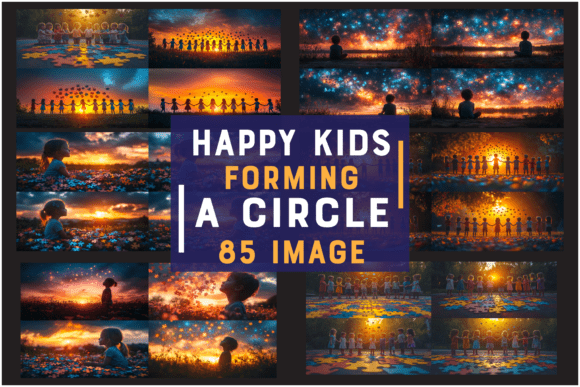
Happy Kids Forming a Circle refers to a curated set of digital illustrations or photographs designed to capture the essence of childhood camaraderie. The core composition involves a group of diverse children arranged in a circle, often engaging in activities like singing, playing, or simply smiling at one another. The circular formation is a powerful psychological symbol representing equality, inclusion, and safety, as no single individual stands above the others.
The specific resource under review consists of 85 high-resolution JPG files. This volume suggests a comprehensive library rather than a single isolated image. High resolution is a critical factor here, ensuring that the images remain crisp when printed on large formats like banners or viewed on high-definition digital displays. The JPG format offers broad compatibility across web browsers, design software, and printing services, making it a practical choice for general use.
Key Use Cases and Applications
The versatility of Happy Kids Forming a Circle allows it to serve multiple industries. When evaluating whether this asset fits your needs, consider the following primary application areas:
- Educational Materials: Textbooks, worksheets, and school posters often require imagery that promotes social skills. These images effectively illustrate concepts like teamwork, sharing, and classroom community.
- School Branding: Institutions use such visuals on websites, brochures, and promotional flyers to project a welcoming and inclusive atmosphere to prospective parents and students.
- Children’s Books: Authors and illustrators may utilize these files for storybook layouts or learning guides where the narrative focuses on friendship and group dynamics.
- Nonprofit and Charity Campaigns: Organizations advocating for children's welfare and education benefit from imagery that emphasizes collective well-being and support systems.
- Social Media Content: Posts regarding teamwork, friendship, and childhood happiness gain engagement when paired with universally recognizable and positive imagery.
- Event Promotions: Flyers and banners for kids' camps, playgroups, and community events rely on this aesthetic to attract families looking for safe, fun environments.
- Marketing and Advertising: Daycare centers, preschools, and activity clubs use these graphics to visually communicate their mission of fostering social development.
- Web App Design: Icons and illustrations for educational websites and apps often need scalable, friendly visuals to guide young users through interfaces.
- Home Decor: Posters and wall art for classrooms, nurseries, and play areas create a stimulating and cheerful environment for children.
- Greeting Cards: Invitations for birthday parties, school events, or summer camp invites often feature this motif to set a celebratory tone.
Benefits and Strategic Advantages
Choosing Happy Kids Forming a Circle offers several strategic advantages for content creators. First, the sheer volume of 85 files provides variety. This reduces the risk of visual repetition within a single campaign or textbook series. Second, the high resolution ensures scalability. A designer can crop a section of the image for a social media thumbnail or use the full canvas for a large-scale event banner without losing quality.
Furthermore, the emotional resonance of the image is immediate. Viewers instinctively understand the message of unity and joy, which reduces the cognitive load required to interpret marketing materials. This makes the asset highly efficient for quick-impact communications, such as social media posts or event flyers where attention spans are short.
Tradeoffs and Considerations
While the benefits are significant, there are tradeoffs to consider before integrating these files into a project. The most notable consideration is the nature of the JPG format. Unlike vector graphics (such as SVG or AI), JPG files are raster-based. If an image needs to be resized significantly beyond its original dimensions, pixelation may occur. While "high resolution" mitigates this, it does not eliminate it entirely for massive print runs like billboards.
Additionally, the generic nature of the "kids in a circle" trope means it is widely used. In highly competitive markets, relying solely on this common visual might make a brand blend in rather than stand out. It lacks the unique specificity of custom photography or bespoke illustration tailored to a specific demographic or cultural context. Users must weigh the convenience of a pre-made library against the desire for total uniqueness.
When This Asset Is a Strong Fit
Happy Kids Forming a Circle is an excellent choice when speed and reliability are priorities. It is particularly strong for:
- Quick Turnaround Projects: When deadlines are tight, sourcing a library of 85 ready-to-use files saves weeks of photo shoots or commissioning artists.
- Budget-Conscious Initiatives: Nonprofits and small schools often operate with limited funds. A comprehensive file pack offers better value per image than hiring a photographer for every flyer.
- General Audience Communication: When the goal is to convey universal values like friendship and safety without needing specific character representation, this asset performs well.
When Alternatives May Be Worth Considering
Conversely, there are scenarios where alternative solutions might be more appropriate. If a project requires hyper-specific representation—such as depicting children with specific disabilities, wearing particular cultural attire, or using sign language—the generic nature of this collection may fall short. In such cases, custom photography or specialized stock searches are necessary.
Furthermore, if the project demands extreme scalability, such as for a stadium-sized mural or a complex vector-based animation, a vector-based illustration library would be superior to a JPG collection. Finally, if a brand strategy relies heavily on distinctiveness and avoiding clichés, investing in original, commissioned artwork might yield a stronger long-term brand identity.
Practical Decision-Making Insights
To determine if Happy Kids Forming a Circle aligns with your goals, ask three key questions: Does the resolution meet my output requirements? Does the visual style match my brand voice? Do I need variety enough to justify a bulk purchase?
If you are creating a series of educational worksheets or a multi-page brochure, the 85-file count ensures you won't run out of options. However, for a single logo or a highly stylized app icon, you might only need one or two images, making a smaller, more targeted search potentially more cost-effective.
Ultimately, this collection serves as a robust toolkit for professionals who need reliable, high-quality imagery to communicate themes of childhood and community. By understanding its strengths in versatility and resolution, alongside its limitations regarding format and uniqueness, stakeholders can make a balanced decision that supports their project objectives efficiently.